HR Processes
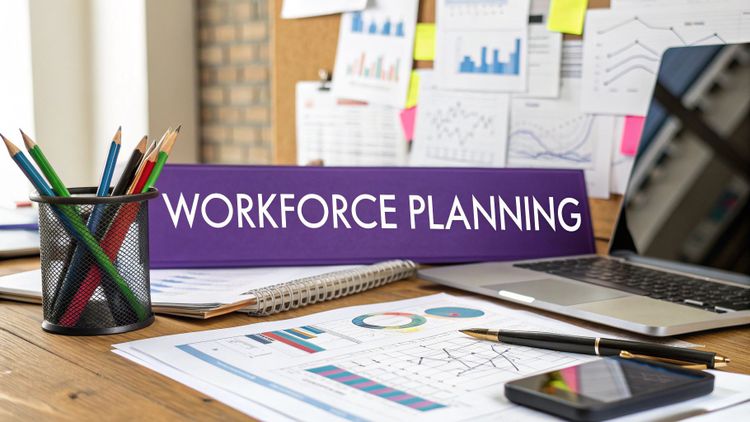
A Guide to Workforce Planning Definition
Strip it all back, and the workforce planning definition is beautifully simple. It’s the strategic art of getting the right people with the right skills into the right roles at precisely the right time.
Think of it as the architect's blueprint for your company’s most valuable asset—its people.
Listen to the podcast here:
What Is Workforce Planning Really?

Many businesses get this wrong, confusing workforce planning with basic headcount forecasting or, worse, just reactive recruitment. But it's a much more forward-thinking and strategic discipline than that. It’s about methodically aligning your business goals with your talent strategy, ensuring you’re ready for future demands, market shifts, and sustainable growth.
The process involves a deep dive into your current team, forecasting what you'll need down the road, and then pinpointing the "gap" between where you are and where you need to be. The final, crucial step is creating a solid action plan to close that gap—whether that means hiring, training, or restructuring.
The Four Pillars of Workforce Planning
To really get to grips with workforce planning, it helps to break it down into its core components. These four pillars are the foundation of any comprehensive strategy that aims to do more than just fill empty seats.
Here's a quick look at how they fit together.
The Four Pillars of Workforce Planning
| Pillar | What It Means for Your Business |
|---|---|
| Supply Analysis | Taking stock of your current team. It’s an audit of the skills, competencies, and untapped potential you already have in-house. |
| Demand Analysis | Looking into the future. This is about forecasting the talent and skills your business will need to hit its strategic goals. |
| Gap Analysis | Connecting the dots. You're identifying the specific shortfalls (or even surpluses) between your current talent supply and future demand. |
| Solution Implementation | Taking action. This means developing and rolling out targeted plans—like recruitment campaigns or upskilling programmes—to close those gaps. |
By mastering these four pillars, your organisation can finally break free from the reactive hiring cycle. You'll shift to a proactive, forward-thinking talent strategy that ensures you're always one step ahead.
It's important to remember that workforce planning isn't just an HR task; it's a core business process that directly links your people to your bottom line. It’s closely related to day-to-day hiring but operates on a much longer-term, strategic level. While recruitment fills today's vacancies, workforce planning anticipates tomorrow's needs.
This proactive approach is a cornerstone of a much broader strategy, and you can see how it all connects in our guide on what talent management is.
Why Workforce Planning Is a Business Imperative in the UK
Not too long ago, workforce planning was often seen as a background HR task—something to get to when you had the time. But in the UK’s current economic climate, that view is dangerously outdated. It’s now a core strategy for survival.
With market instability, ongoing labour shortages, and immense financial pressures, simply reacting to hiring needs as they pop up is no longer a viable option. It's a recipe for disaster.
Without looking ahead, businesses risk getting blindsided by critical skill gaps right when they need to be most agile. They become sitting ducks for high employee turnover as staff look for more stable ground, and they can’t pivot fast enough when the market shifts, handing a massive advantage to competitors who were better prepared.
Workforce planning is what transforms a business from a reactive one, constantly putting out fires, into a resilient organisation that can navigate uncertainty with confidence. It’s about building a talent infrastructure that can actually withstand economic shocks.
This isn’t just theory; the data backs it up. The net employment balance—a key indicator of hiring confidence—plummeted to just +8 in the spring, a huge drop from +13 the previous quarter. Outside of the pandemic, that's the lowest it’s been since 2014, with a worrying 24% of employers planning redundancies. For a deeper dive, you can explore the latest UK labour market trends to understand the full picture.
Navigating the Risks of a Volatile Market
Ignoring workforce planning right now exposes a company to some very real, very painful risks. These aren't just abstract threats on a spreadsheet; they are practical challenges that can derail even the most solid businesses. Think of it as trying to navigate a storm without a map.
Here are some of the key risks you face:
- Being Outmanoeuvred by Skill Shortages: You might suddenly find your growth plans have stalled simply because you don't have the right people with skills in data analytics or AI. Meanwhile, your competitors who planned ahead are pulling away.
- Losing Top Talent: When restructuring or redundancies are handled reactively, your best people often jump ship due to the uncertainty. This creates a talent drain that's both difficult and incredibly expensive to reverse.
- Making Costly Hiring Mistakes: Panic hiring to fill an unexpected gap almost always leads to a bad hire. You end up with poor cultural fits or underqualified candidates, which just drives up turnover and recruitment costs.
Building Resilience Through Strategic Foresight
When it comes down to it, effective workforce planning is a cornerstone of organisational resilience. It gives you the power to see challenges on the horizon before they become full-blown crises. By knowing what skills you have and forecasting what you’ll need, you can build a talent pipeline that is both strong and flexible.
This proactive approach also means staying on top of your legal obligations as an employer. Any plan for restructuring, hiring, or redundancy must be handled with extreme care to comply with strict UK regulations. To get up to speed, check out our essential guide to UK employment law compliance.
By weaving legal awareness into your planning from the start, you not only protect the business but also build a foundation of trust with your entire team.
Building Your Strategic Workforce Plan
Knowing the definition of workforce planning is one thing; turning that theory into a practical, powerful strategy is where the real work begins. A strategic workforce plan shouldn't be some complex document shrouded in HR jargon. Think of it as a clear roadmap, built on four logical stages that anyone in the business can get behind.
It’s a bit like building a bridge. You first need to know exactly where you're starting from (one side of the river) and where you want to end up (the other side). Only then can you actually design the structure to connect the two. Workforce planning follows that exact same logic.
Stage 1: Supply Analysis
The first stage, Supply Analysis, is all about looking inward. Before you can even think about the future, you need a crystal-clear picture of the talent you already have on the payroll. This goes way beyond a simple headcount; it's a deep audit of your current team's skills, qualifications, and even their potential to grow.
You're essentially asking: "What capabilities do we have in-house right now?" This involves mapping out every role, pinpointing your top performers, and truly understanding the specific skills that are driving your success today.
Stage 2: Demand Analysis
Next up is Demand Analysis, where you shift your focus from the present to the future. This is where you connect your company's big-picture goals—like expanding into a new market or launching a new product—to the people you'll need to make it happen. This stage is all about forecasting.
You'll start asking some critical questions:
- What new roles will our five-year business plan demand?
- Which skills are going to become essential as our technology evolves?
- How will upcoming retirements impact our leadership pipeline?
This forward-looking perspective makes sure your talent strategy is directly fueling your business ambitions. It’s about getting ahead of your needs, not just reacting when it’s already too late.
Stage 3: Gap Analysis
Once you have a handle on your current supply and future demand, you can move to the most crucial stage: Gap Analysis. Here, you bring the first two stages together to identify the specific shortfalls—or even surpluses—between the workforce you have and the one you're going to need.
This is the heart of your workforce plan. It pinpoints exactly where your biggest talent risks and opportunities lie, giving you a clear, prioritised list of problems to solve.
For example, your analysis might reveal a critical shortage of data scientists needed for a planned AI project, or maybe an excess of administrative staff whose roles are likely to be automated in the near future.
Stage 4: Solution Implementation
Finally, Solution Implementation is where you roll up your sleeves and take action. With a clear map of your talent gaps, you can build targeted strategies to close them. And this isn't just about hiring more people; it’s about creating a multi-faceted action plan.
Your solutions might include a mix of the following:
- Recruitment: Launching targeted hiring campaigns to bring in fresh skills.
- Training and Development: Upskilling your existing employees to fill future roles from within.
- Succession Planning: Grooming your internal high-flyers for key leadership positions.
- Restructuring: Reorganising teams to better align with new business goals.
This final stage turns all your analysis into tangible results. Crafting this part of the plan can feel complex, but using a pre-built framework can help structure your thoughts. For a great starting point, check out this complete recruitment strategy template to guide your efforts.
A Practical Guide to Implementing Your Plan
Knowing the theory behind workforce planning is one thing, but putting it into practice is where you’ll see genuine business results. A successful rollout isn’t a one-off project; it’s a living process that turns your strategic insights into tangible actions. Think of this as your roadmap for bringing a workforce plan to life.
Stage 1: Align with Strategic Business Goals
First things first: your workforce plan can't exist in a bubble. The most critical step is tying it directly to your company's bigger picture. Are you aiming to crack a new market? Launch a new product line? These high-level goals will dictate the exact skills and roles you need to bring on board.
This alignment ensures your talent strategy is more than just an HR task—it becomes a core driver of the entire organisation's success. It answers the big question: "What people do we need to hit our specific business targets over the next three to five years?"
Stage 2: Gather and Analyse Workforce Data
Once you know where you're heading, it's time to get your hands dirty with data. This stage is all about collecting and making sense of key metrics from your current team to create a baseline. Without solid data, you're just guessing.
A few key metrics you’ll want to focus on include:
- Turnover Rates: Who is leaving, from which departments, and why? This tells you a lot about your weak spots.
- Time-to-Fill: How long does it actually take to get someone hired for an open role?
- Skills Inventory: What competencies and qualifications do your employees already have? You might be sitting on untapped talent.
- Demographics: Analysing things like age, tenure, and retirement eligibility helps you see potential gaps on the horizon.
Stage 3: Develop Future Scenarios
The future is famously unpredictable, so great workforce planning isn't about having a single, rigid forecast. Instead, it’s about creating multiple "what if" scenarios. You'll map out a range of possibilities, from best-case growth to a worst-case economic downturn. This prepares you to be agile, no matter what comes your way.
For example, the UK vacancy market has been contracting for a while now, which completely changes how companies plan. The number of vacancies fell by 9,000 between July and September, down to 717,000—the 39th consecutive quarterly drop. In this kind of climate, the focus naturally shifts from aggressive hiring to retaining the talent you have and boosting efficiency. You can dig into more of these UK labour market statistics to inform your planning.
This visual breaks down a simple framework for working through your supply, demand, gaps, and solutions.
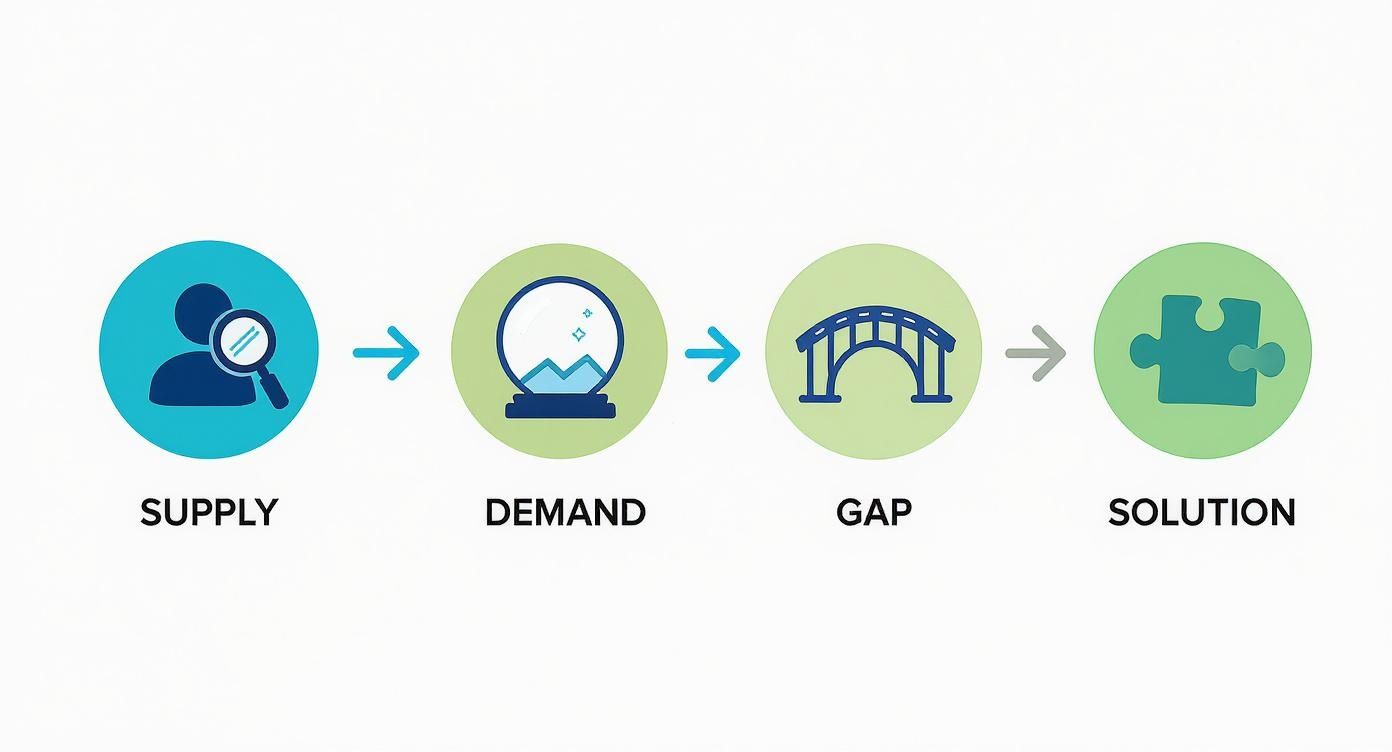
This process helps you connect the dots, moving from an analysis of what you have and what you'll need, to building a concrete plan to bridge that gap.
Stage 4: Create and Implement Your Action Plan
With your data crunched and scenarios mapped out, it's time to build your action plan. This is where you get specific about the initiatives needed to close those talent gaps you’ve identified. Your plan should be a practical mix of strategies tailored to your company's unique situation.
A great workforce plan doesn't just identify problems; it creates clear, actionable solutions. The goal is to build a detailed roadmap that outlines specific steps, assigns ownership, and sets realistic timelines for completion.
Your initiatives might include launching targeted hiring drives. Getting that right requires a solid strategy, and you can learn more about how to create and manage an effective recruitment campaign in our detailed guide. Other actions could involve developing internal training programmes to upskill your existing team or establishing a formal succession plan for your most critical roles.
Stage 5: Monitor, Evaluate, and Adapt
Finally, workforce planning is not a "set it and forget it" task. The business world is constantly changing, and your plan has to keep up. Make sure you schedule regular reviews—quarterly or bi-annually works well for most—to check your progress, see if your initiatives are working, and make adjustments as needed.
This continuous loop of monitoring and adapting is what keeps your strategy relevant and impactful for the long haul.
Future-Proofing Your Workforce Strategy

A workforce plan you create today can be obsolete tomorrow. The world of work is shifting at a remarkable pace, and a static, once-a-year planning cycle just won’t cut it anymore if you want to stay competitive.
To truly future-proof your organisation, your strategy needs to be dynamic and adaptive. It must be tuned into the trends reshaping the UK talent market, moving beyond simple headcount forecasts to embrace a more fluid, forward-thinking approach.
The Impact of Technology and Automation
Artificial intelligence and automation are changing how every business operates. While some roles might be displaced, technology is also creating entirely new ones centred on data, AI management, and digital transformation. Smart planning doesn't just anticipate job losses; it identifies the new skills your team will need to work alongside these powerful tools.
Your plan needs to answer some critical questions:
- Which tasks can we automate to free up our people for higher-value work?
- What training do we need to upskill our current team for a tech-driven future?
- How can we attract talent with the specialised digital skills we’re missing?
Bringing in new tech isn't just about efficiency—it's about building a team that’s ready for whatever comes next. Ignore these shifts, and you risk creating significant skill gaps that can bring your growth to a grinding halt. You can explore more about the tech trends that will dominate recruitment in our detailed analysis.
Responding to New Employee Expectations
It’s not just tech that’s changing; the expectations of the UK workforce have shifted dramatically, too. People today are looking for more than just a salary. To attract and keep top talent, your workforce planning must account for evolving priorities like job security, skills development, and a positive workplace culture.
A human-centric approach is no longer optional. It's about building an adaptable, compliant, and engaging work environment that becomes a magnet for the best people in your industry.
Recent insights show that 80% of UK workers prioritise job security, and 70% want opportunities to develop transferable skills. What’s more, 73% value working with great colleagues. This proves that your planning must now account for cultural and social factors right alongside technical skills.
By building a plan that actively addresses these needs, you create a more resilient and motivated workforce that's ready for any challenge.
Still Have Questions About Workforce Planning?
Even when you've got the basics down, it's natural for practical questions to pop up when you start applying the theory. Let's tackle some of the most common queries that come up, giving you straightforward answers to help you get started with confidence.
What Is the Difference Between Workforce Planning and Recruitment?
It’s easy to get these two mixed up, but they really operate on different clocks and for different reasons. The simplest way to think about it is this: recruitment is tactical, while workforce planning is strategic.
Recruitment is all about the here and now. A role opens up, and the recruitment team gets to work finding the best person for that specific job, right away. It's a reactive process designed to solve today’s staffing puzzle.
Workforce planning, on the other hand, is about looking over the horizon. It digs into the entire business strategy to figure out what talent you’ll need in one, three, or even five years. It’s not just asking, "Who do we need today?" It’s asking, "What skills will we need to hit our long-term goals, and what’s our game plan to get them?"
Recruitment is about filling a seat on the bus. Workforce planning is about making sure the bus is heading in the right direction and has the right crew on board for the entire journey.
How Often Should a Workforce Plan Be Reviewed?
A workforce plan can't be a one-and-done document that you file away and forget. The world of work simply moves too fast for that. For most UK businesses, a good rhythm is a major review annually, with lighter check-ins quarterly.
- Annual Review: This is your deep dive. You'll want to properly align the plan with the new year's business objectives, analyse any big market shifts, and make significant adjustments based on what you’ve learned.
- Quarterly Check-ins: Think of these as quick pulse checks. Are you on track with your hiring or training goals? Has anything unexpected happened, like a key person resigning or a major new project landing on your plate?
This regular cadence ensures your plan stays a living, relevant guide rather than a historical artefact.
Can Small Businesses Benefit from Workforce Planning?
Absolutely. In fact, you could argue it's even more critical for small businesses. When you have a smaller team, every single hire carries enormous weight. One bad hire or an unforeseen skill gap can rock a small to medium-sized enterprise (SME) in a way it just wouldn't for a huge corporation.
For an SME, the plan doesn't need to involve complex data models. It's more about nailing the fundamentals:
- Mapping Critical Roles: Pinpointing the key positions that are absolutely essential for keeping the lights on and fuelling growth.
- Cross-Training Staff: Building resilience so that if one key person is off, the whole operation doesn't grind to a halt.
- Future-Proofing Skills: Simply thinking about what skills you’ll need in the next 12-18 months to keep your competitive edge.
Even a simple, informal workforce plan helps SMEs make smarter, more strategic decisions that pave the way for sustainable growth.
What Are the Most Common Mistakes to Avoid?
By far, the biggest mistake is treating workforce planning as a one-off HR project. It needs to be an ongoing business process. Another classic pitfall is failing to get genuine buy-in from senior leadership, which dooms the initiative to fail from a lack of resources and authority.
Finally, too many businesses plan in a silo. They create a talent strategy that isn't directly and explicitly tied to their core business objectives, making it irrelevant before it even gets off the ground.
Ready to turn your strategic workforce plan into an effective hiring reality? SeeMeHired provides an all-in-one applicant tracking system that simplifies every stage of recruitment, from posting jobs to onboarding new hires. Discover how you can attract better talent faster at https://seemehired.com.