HR Processes
Crafting Effective Policies in a Company

Company policies are the official guidelines and principles that steer an organisation’s conduct, operations, and day-to-day decisions. Think of them as a strategic framework, making sure everyone is on the same page and knows what to expect.
Listen to the podcast here:
The Blueprint for Business Success
Imagine trying to build a house without a detailed architectural plan. The result would be unstable, unsafe, and completely unpredictable. It’s the same with a business – an organisation without clear policies is operating on guesswork, leaving it wide open to internal confusion and external risks.
These documents are so much more than a list of rules; they are the very foundation supporting your entire operation.
Well-crafted company policies bring essential clarity, empowering employees to do their jobs effectively and with confidence. When everyone understands the correct procedure for everything from requesting annual leave to handling sensitive customer data, ambiguity vanishes, and efficiency naturally follows. This is how you build a predictable and fair working environment for all.
Protecting Your Organisation from Risk
Beyond creating operational harmony, policies are your first and most critical line of defence. They are proactive tools designed to shield your business from serious legal, financial, and reputational harm. By setting out clear guidelines, you ensure your organisation operates within the law – a non-negotiable in today's business world.
For example, robust policies help you:
- Ensure Legal Compliance: Keeping up with UK regulations on everything from data protection (GDPR) to health and safety is crucial. Our guide on UK employment law compliance offers essential strategies for staying on the right side of the law.
- Mitigate Liability: Clear anti-harassment and discrimination policies can dramatically reduce the risk of costly legal disputes and protect your company’s hard-earned reputation.
- Safeguard Company Assets: IT security and acceptable use policies protect your digital infrastructure and confidential information from both internal misuse and external threats.
Shaping a Positive Company Culture
Ultimately, your policies are instrumental in shaping the very culture you want to build. They are how you translate your company's values into tangible, everyday actions and behaviours. A policy that champions flexible working shows a real commitment to work-life balance, just as a transparent promotions policy fosters a culture of fairness and meritocracy.
A company's policies are a direct reflection of its values. They aren't just about preventing bad things from happening; they are about actively creating a positive, equitable, and productive environment where people can do their best work.
Instead of seeing them as restrictive red tape, the most successful leaders view policies as strategic assets for sustainable growth. They provide stability during times of change, guide decision-making at every level, and build a solid foundation of trust between employer and employee. This framework is what allows a business to scale effectively, confident that its core principles are being applied consistently across the entire organisation.
Mapping Your Core Business Policies
Think of your business as a ship navigating the open seas. To get anywhere safely and efficiently, you need a map. That's exactly what your corporate policies are: an essential map that provides clear guidance for your entire crew. They aren't just one giant, dusty rulebook but a collection of specific guides for different parts of your organisation, making sure everyone knows the route and the rules of the voyage.
To create a sturdy operational framework, it’s best to group your policies into logical categories. This simple step makes them much easier to manage, share, and update as your business grows. Most of the time, essential business policies fit neatly into one of three buckets: Human Resources, Information Technology, and Compliance.
Let’s take a closer look at what goes into each.
Human Resources Policies That Shape Your Culture
Human Resources (HR) policies are probably the ones your employees interact with the most. They’re the foundation of the relationship between your company and your team, setting crystal-clear expectations for behaviour, professional conduct, and how people treat one another. Ultimately, these are the documents that bring your company culture to life.
Key HR policies usually include:
- Code of Conduct: This is the North Star for your company culture, outlining the expected standards of behaviour, ethics, and professionalism for absolutely everyone on the team.
- Anti-Harassment and Discrimination Policy: A non-negotiable policy that clearly defines and prohibits any form of harassment or discrimination. It must detail the exact procedures for reporting and investigating incidents to create a genuinely safe and inclusive environment.
- Equal Opportunity Employment Policy: This formalises your promise to make hiring and promotion decisions based on merit alone, not on any protected characteristics. It’s about ensuring fairness from day one.
These policies do far more than just tick a legal box; they actively build a workplace grounded in trust and respect. It's simple, really: when people feel safe and valued, they're more engaged and more likely to stick around for the long haul.
The infographic below really brings this to life, showing how policies act as the blueprint, framework, and guide for everything you do.

As you can see, it all starts with a foundational blueprint. This informs the structural framework of the business and, from there, provides the daily operational guide that your team uses to navigate their work.
Information Technology Policies That Protect Your Assets
In today's world, a company's data and digital systems are just as valuable as its physical assets, if not more so. Information Technology (IT) policies are your defence against a whole host of digital threats—both internal and external—and are critical for keeping the business running smoothly and protecting sensitive information.
Imagine this: without a clear policy on data security, a well-meaning employee could accidentally share sensitive customer details, leading to a disastrous data breach. We’re not just talking about a bad press day; one study revealed that the average cost of a data breach for UK businesses was a staggering £3.4 million. That figure alone shows the enormous financial risk of not having solid IT governance in place.
Essential IT policies include:
- Data Security Policy: This spells out exactly how sensitive company and customer data must be handled, stored, and sent to prevent unauthorised access.
- Acceptable Use Policy (AUP): This document clarifies what employees are allowed to do on company networks, devices, and software. It’s all about preventing misuse that could open the door to security risks.
- Remote Work Policy: With so many teams working flexibly, this policy has become indispensable. It covers security requirements, equipment rules, and communication expectations for anyone working outside the office. If you're looking to craft one, our guide on how to create a balanced remote work policy is a great place to start.
A strong set of IT policies acts as a digital shield. It empowers employees to use technology confidently and securely while protecting the organisation from cyber threats that can disrupt operations and erode customer trust.
Compliance Policies That Keep You on the Right Side of the Law
Finally, we have compliance policies. These are the rules that make sure your business operates within the strict boundaries of the law and industry-specific regulations. These aren't suggestions; they’re mandatory. Failing to follow them can lead to serious consequences, including eye-watering fines and legal battles. Think of them as the guardrails that keep your business on the straight and narrow.
To give you a better idea of how these core policy types work together, here's a quick breakdown.
Essential Policy Categories and Their Core Functions
This table summarises the main types of company policies and the critical organisational functions they support.
| Policy Category | Primary Function | Example Policies |
|---|---|---|
| Human Resources | Govern the employee-employer relationship and shape company culture. | Code of Conduct, Anti-Harassment, Equal Opportunity, Leave Policy |
| Information Technology | Protect digital assets, ensure data integrity, and manage technology use. | Data Security, Acceptable Use, Remote Work, Password Policy |
| Compliance | Ensure adherence to legal, regulatory, and ethical standards. | Health and Safety, GDPR/Data Protection, Whistleblowing, Anti-Bribery |
As you can see, each category has a distinct but vital role to play in the health of your organisation.
Key compliance policies to focus on include:
- Health and Safety Policy: This is a legal must-have for most UK businesses. It outlines the procedures needed to maintain a safe working environment and minimise the risk of accidents.
- GDPR and Data Protection Policy: This governs how you collect, handle, and store personal data, ensuring you comply with the General Data Protection Regulation and protect people's privacy.
- Whistleblowing Policy: This provides a safe and confidential way for employees to report wrongdoing without fearing comeback, which helps build a culture of integrity and accountability.
Together, these three categories—HR, IT, and Compliance—form the complete map of policies in a company. By putting real thought into each area, you create a solid framework that supports your people, protects your assets, and makes sure your business runs ethically and legally. This kind of structure provides the stability you need for genuine, long-term success.
Why Smart Policies Are a Business Superpower
It’s easy to write off company policies as just more red tape. A bureaucratic chore. But that's a huge mistake. In reality, well-crafted policies in a company are a genuine strategic advantage—a business superpower that strengthens your entire organisation from the inside out. They're not a cost centre; they're a powerful investment that delivers serious returns in stability, productivity, and growth.
Think about what happens when processes aren't clearly defined. Ambiguity creeps in. Employees waste precious time figuring out who to ask, what steps to follow, or if they’re even allowed to take a certain action. That indecision creates friction and slows the whole business down.
Smart policies get rid of that confusion. By standardising routine operations—from submitting expenses to getting a project approved—you create a predictable and efficient environment where everyone knows the right way to get things done.
Boosting Operational Efficiency and Clarity
When you standardise processes, you ensure consistency and quality across the board. Every task gets performed the same way, every time, which cuts down on errors and makes your output far more reliable. This kind of operational consistency is the bedrock of any business that wants to scale.
Clear policies act as a compass for your team, providing direction and removing guesswork. This allows employees to focus their energy on high-value work instead of getting bogged down in procedural uncertainty.
This newfound efficiency has a direct impact on your bottom line. Research shows that organisations with highly engaged employees—often a result of a clear and supportive work environment—are 23% more profitable. When people aren't wrestling with confusing procedures, they're more focused, productive, and committed to their roles.
Mitigating Legal and Compliance Risks
Beyond just efficiency, policies are your primary shield against legal threats. Employment law in the UK is complex and always changing. Without clear, written guidelines that align with current legislation, your business is exposed to some major risks, including wrongful dismissal claims, discrimination lawsuits, and hefty fines.
For example, a robust anti-harassment policy doesn't just say "harassment is forbidden." It needs to clearly outline:
- What specific behaviours are considered harassment.
- The exact steps an employee should take to report an incident.
- A transparent process for how the company will investigate the claim.
This level of detail gives you legal protection by proving you've taken reasonable steps to prevent and address misconduct. It protects both your employees and the company, creating a safer environment for everyone. Without this framework, you’re basically navigating a legal minefield without a map.
Fostering a Positive and Fair Company Culture
Perhaps the most powerful benefit of smart policies is how they shape a positive company culture. Policies are where your company values stop being just words on a wall and become tangible, everyday actions. They are the mechanism for building trust, fairness, and psychological safety.
When things like promotions, pay rises, and disciplinary actions are governed by clear and consistently applied policies, it stamps out any perception of favouritism. Employees can see that decisions are made based on merit and established criteria, not office politics. That kind of transparency is fundamental to building a culture of trust and respect.
Furthermore, supportive policies on flexible working, mental health, and professional development show your team you value them as people, not just cogs in a machine. A report from the Society for Human Resource Management (SHRM) found that 94% of employees would stay at a company longer if it invested in their learning and development.
These policies directly lead to higher morale, better engagement, and stronger long-term retention. By automating many of these routine HR tasks, you can learn more about how to automate HR with top features that give you back the time to focus on your people. This is how strong policies in a company transform from simple documents into the engine of a thriving, resilient, and successful organisation.
How to Create Policies That Actually Work

Creating policies in a company that people actually follow is more of an art than a science. It’s all about crafting guidelines that are practical, clear, and respected—not just another document filed away in a digital folder somewhere.
Let’s be honest: a policy that doesn't work in the real world is worse than having no policy at all. It just creates confusion and quietly signals that rules are optional.
The secret is to treat policy creation not as a top-down command, but as a thoughtful, collaborative process. A great policy should solve a real problem, reflect your company's culture, and be simple enough for everyone to understand and apply.
So, let's break down the essential steps to get it right.
Start by Assessing Your Needs
Before you even think about writing a single word, you need to understand why you need a policy in the first place. Are you trying to fix a recurring issue, meet a new legal requirement, or bring some order to a chaotic process? Kicking off with a clear purpose is non-negotiable.
To get to the heart of the matter, involve the people who will be most affected. Chat with department heads and the employees on the ground floor. Their insights are gold, ensuring the policy is practical and not just a theoretical exercise cooked up in a boardroom.
- Identify the Core Problem: What specific issue is this policy meant to solve?
- Consult with Stakeholders: Gather feedback from managers and team members who will use the policy daily.
- Define Success: What does a successful outcome look like once this policy is in action?
This initial research phase ensures your policy is grounded in reality and gets buy-in from the very beginning.
Draft with Simplicity and Clarity
Once you’ve nailed down the ‘why’, it’s time to start drafting. The single biggest mistake companies make here is falling back on complex legal jargon or stuffy corporate language. An effective policy has to be easy for everyone to read and understand, from a new starter to a senior executive.
A policy isn't a legal treatise; it's a practical guide for daily work. Use simple, direct language. Avoid acronyms and technical terms where you can, and if you must use them, always provide a clear definition.
Break the policy down into logical sections with clear headings. Use bullet points and short paragraphs to make the information easy to digest. Remember, the goal is for people to actually understand it, not to impress them with your vocabulary.
Always Seek a Legal Review
While you should always write for clarity, you absolutely must ensure your policies are legally sound. This is especially crucial for documents covering employment, health and safety, and data protection.
Once you have a solid draft, it's vital to get it reviewed by a legal professional who specialises in UK employment law. This simple step protects your business from accidental non-compliance, which can lead to hefty fines and serious legal trouble. A legal review ensures your policy not only meets current regulations but is also worded to minimise risk.
Plan Your Communication and Rollout
How you introduce a new policy is just as important as the policy itself. A surprise email with a dense PDF attached is a guaranteed recipe for resistance and confusion. A thoughtful communication plan, on the other hand, builds understanding and acceptance right from the start.
Your rollout strategy should include:
- Announce in Advance: Let employees know a new policy is coming and, crucially, explain the reasons behind it.
- Provide Training: Hold sessions (in-person or virtual) to walk through the policy, highlight the key points, and answer any questions.
- Make it Accessible: Store the policy in a central, easy-to-find place, like the company intranet or a shared drive.
Introducing new policies is also a key part of welcoming new team members. For more tips on this, you can check out our guide on how to create a standout onboarding process.
Establish a Regular Review Cycle
Finally, no policy should be set in stone. The business world is constantly changing, and your policies must adapt to stay relevant and effective. In the UK, employment laws and economic conditions can shift quickly, directly impacting your operations.
For example, the recent focus on workforce resilience and mental health support has become a major consideration. With 91% of UK adults reporting high or extreme stress levels, companies are increasingly building policies that support a healthier work-life balance. You can discover more insights about the UK policy outlook on iod.com.
Set a calendar reminder to review every major policy at least once a year. This regular check-up ensures your guidelines remain compliant, relevant, and perfectly aligned with your company’s evolving goals and culture.
Building Business Resilience Through Policy
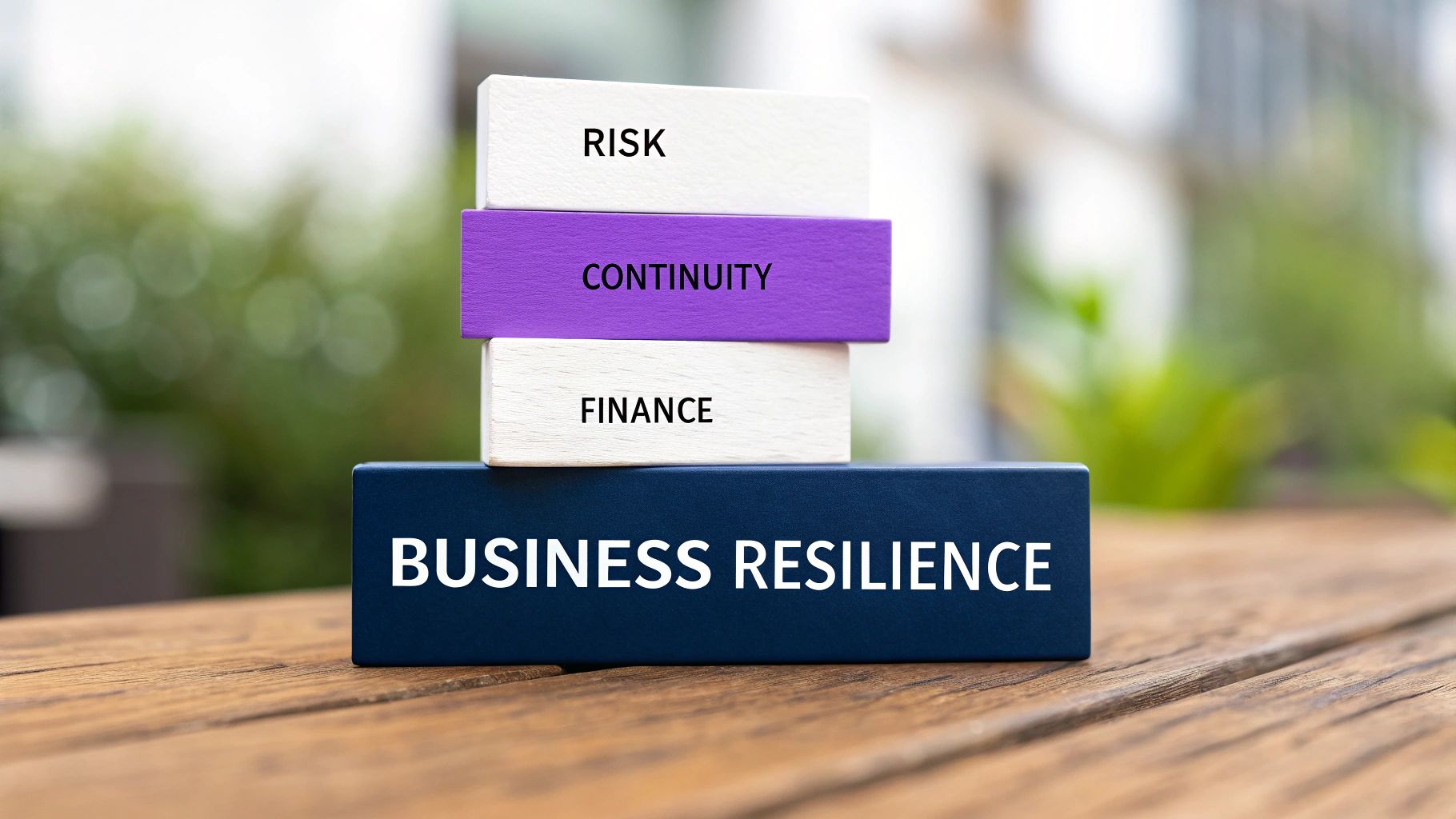
Effective policies in a company are so much more than just operational rulebooks; they are the very foundation of organisational resilience. Think of them as the shock absorbers for your business, specifically engineered to handle the jolts of economic downturns, market swings, and whatever crisis comes next.
Without these foundational guardrails, a business is left dangerously exposed. Even minor setbacks can quickly snowball into major threats, putting everything from cash flow to operational stability at risk. Good policies act as your first line of defence, giving you a clear, predictable framework when you need it most.
Policies as a Financial Shield
Financial resilience is arguably the most crucial ingredient for long-term survival. Clear policies around financial management aren't just about good bookkeeping—they're about proactively securing your company's future. These policies instil the discipline needed to navigate choppy economic waters.
Essential financial policies for resilience include:
- Risk Assessment Protocols: These outline how your business spots, evaluates, and deals with financial risks, whether it's a supply chain hiccup or a sudden drop in customer demand.
- Liquidity and Cash Flow Management: A solid policy here ensures you always have enough cash on hand and a plan for managing payments and receivables when things get tight.
- Business Continuity Plans: This is your detailed playbook for how the business will keep the lights on during and after a major disruption, ensuring customers and revenue are impacted as little as possible.
These documents are designed to be proactive, not reactive. They make sure that when a crisis hits, you have an agreed-upon plan ready to go, taking panic and indecision out of the equation.
Strong financial and operational policies shift your business from just reacting to market shocks to being proactively prepared. They are the structural supports that allow a company to bend without breaking.
The consequences of not having these frameworks in place can be severe. Recent data from the UK government paints a stark picture, showing that company insolvencies in England and Wales have hit a decade-long high, driven largely by economic pressures. This spike highlights just how vital it is to have policies that tackle financial risk head-on. You can read more about these UK insolvency trends on GOV.UK.
Safeguarding Your Entire Organisation
At the end of the day, building resilience is a holistic effort that goes far beyond the finance department. It’s about creating a stable, compliant, and adaptable organisation that’s ready for anything. Your HR and compliance policies play a huge part in this, ensuring your team stays secure, engaged, and aligned with legal duties, even when the pressure is on.
For instance, having clear recruitment compliance policies is essential for navigating the complexities of UK employment law. This protects your business from legal risks that can be especially damaging during a downturn. To sharpen your approach, take a look at our essential guide to recruitment compliance in the UK.
By weaving resilience into your corporate DNA through well-thought-out policies, you're doing more than just preparing for a worst-case scenario. You are building a stronger, more agile, and more sustainable business that is equipped to thrive, no matter the environment. This strategic approach to policies in a company is what separates businesses that merely survive from those that truly succeed.
Managing Risk with Smart Insurance Policies
It’s tempting to look at insurance as just another line item in the budget—a box you have to tick to stay compliant and then promptly forget about. But thinking this way misses the point entirely. Smart insurance policies in a company are your financial safety net, a core part of your business’s ability to bounce back when things inevitably go sideways.
This isn’t just about compliance; it’s about survival.
Being uninsured or, just as dangerously, underinsured leaves a business wide open to disaster. A single unexpected event—a flood, a data breach, a liability lawsuit—can unleash a financial tidal wave that many companies, especially smaller ones, simply can’t withstand.
The Underinsurance Gap in the UK
And this isn’t some far-off, hypothetical problem. It’s happening right here, right now. The latest figures for UK SMEs are quite sobering, revealing that a staggering 44% have no commercial insurance whatsoever. Even worse, estimates suggest that 40% to 50% of businesses are underinsured, meaning their policy wouldn’t come close to covering the actual cost of a major incident. You can dig deeper into these UK business insurance statistics on money.co.uk. This gap leaves a massive number of companies dangerously exposed.
Viewing insurance as an active risk management tool rather than a passive cost is a critical mindset shift. It’s the difference between hoping for the best and being prepared for the worst.
This means your insurance shouldn’t exist in a silo. It should be woven into the fabric of your other risk management efforts. For example, your health and safety protocols should directly influence your public and employers' liability insurance. Your cybersecurity measures should be in lockstep with your cyber insurance policy. They need to work together, creating reinforcing layers of protection.
Keeping Your Coverage Current
Insurance is definitely not a "set it and forget it" activity. The world changes, and so do the risks your business faces. Things like inflation, supply chain headaches, and new technology mean that a policy that was perfectly fine two years ago might be critically inadequate today.
To make sure your coverage is actually up to the job, you need to:
- Conduct Annual Reviews: Make it a yearly ritual to sit down with your insurance broker. Go over your business's needs, assets, and potential liabilities to see what’s changed.
- Update Asset Valuations: Inflation is a silent killer of insurance policies. The cost to replace buildings, equipment, and stock can skyrocket, so you need to update these values regularly to avoid a painful shortfall when you need to make a claim.
- Assess New Risks: Are you dealing with new cyber threats from a remote workforce? Are there fresh vulnerabilities in your supply chain? Identify these emerging risks and make sure your policies have you covered.
By treating your insurance as a living document, you turn it from a static expense into a dynamic shield that actively protects your business's future.
Common Questions About Company Policies
Even when you know why policies are important, putting them into practice always throws up a few questions. It’s completely normal.
Getting clear, straightforward answers is key. It helps you build guidelines that people actually respect, rather than creating another document that just gathers dust on a server. Let's tackle some of the most common queries we hear from business leaders.
How Often Should We Review Our Policies?
Think of your company policies like a car's MOT—they need regular checks to make sure they're still fit for purpose. A good rule of thumb is to review every major policy at least once a year.
But sometimes, you’ll need to act faster. A major change in UK employment law, a big shift in how you work (like moving to a permanent hybrid model), or an incident that reveals a gap in your guidelines should all trigger an immediate review. The goal is to keep your policies as living documents that evolve with your business, not static rules that quickly go out of date.
Policy vs Procedure: What Is the Difference?
This is a classic point of confusion, but the distinction is actually quite simple. A policy tells you the "why" and the "what," while a procedure lays out the "how."
Think of it like this: a policy is the destination on a map, and the procedure is the turn-by-turn directions to get you there.
- Policy: This is your guiding principle. For example, "Our company is committed to providing a safe and healthy working environment for all employees." It's the high-level rule.
- Procedure: These are the step-by-step instructions. This would be the detailed checklist for reporting a safety hazard, including who to contact, which forms to complete, and the expected timeline for a response.
A policy sets the standard; a procedure gives your team the exact steps to meet it. You really need both for the framework to hold up.
"A policy is the strategic rule that guides decisions, while a procedure is the tactical set of actions required to implement that rule. One provides the direction, the other provides the instructions."
Can We Use a Template for Our Policies?
Absolutely. Using a template can be a brilliant starting point, especially for standard documents like a health and safety or an acceptable use policy. They save a huge amount of time and can ensure you cover all the essential legal bases.
However, you should never just copy and paste a template and call it a day. It’s crucial to customise it to reflect your company's specific culture, day-to-day operations, and unique risks. A generic policy that doesn’t align with how your team actually works is guaranteed to be ignored. Use templates as your foundation, but always make them your own before sending them for a final legal review.
Ready to streamline not just your policies, but your entire hiring process? SeeMeHired provides an all-in-one platform to manage everything from job postings and candidate shortlisting to onboarding and compliance, ensuring your recruitment is as efficient and effective as your new policies. Learn more at https://seemehired.com.