SeeMeHired Insights
What Is a Screening Interview and How to Pass One
A screening interview is a quick, initial chat recruiters use to see if a candidate’s basic qualifications, interest, and practical needs are a good match for an open role. Think of it as the first filter in the hiring process.
Listen to the podcast here:
Your First Hurdle in the Hiring Process
Imagine a movie trailer. It doesn't give away the entire plot, but it shows you just enough to decide if you want to buy a ticket. A screening interview works in much the same way. Its main goal isn't to pinpoint the perfect employee right then and there, but to efficiently whittle down a huge applicant pool into a manageable shortlist for hiring managers.
This initial conversation is a crucial gatekeeper. With some job ads pulling in an average of 340 applicants, companies desperately need a way to spot the most promising candidates without getting bogged down. In fact, only about 2% of applicants typically make it to later interview stages, which really underscores just how important this filtering step is.
A screening interview is less about diving deep into your expertise and more about making sure the fundamentals align. It’s a high-level check to ensure both you and the employer are on the same page before anyone invests more time.
This stage is all about quickly verifying three key things:
- Core Qualifications: Do you have the non-negotiable skills and experience laid out in the job description?
- Genuine Interest: Are you genuinely excited about this role and this company, or are you just firing off applications everywhere?
- Logistical Alignment: Do your salary expectations, start date, and location work with what the company can offer?
Getting these questions out of the way upfront saves everyone a massive amount of time. Once you understand its function as a high-level filter, you're in a much better position to navigate this chat and move on to the next round.
Screening Interview At a Glance
Here’s a quick breakdown of what a screening interview really boils down to. It's all about speed, efficiency, and checking those essential boxes.
| Characteristic | Description |
|---|---|
| Purpose | To quickly filter a large pool of applicants and create a shortlist of qualified candidates. |
| Duration | Typically 15-30 minutes. Short and to the point. |
| Conducted By | Usually a recruiter or an HR generalist, not the hiring manager. |
| Format | Most often a phone call or a brief video call. |
| Focus | Verifying basic qualifications, experience, salary expectations, and logistical details. |
| Outcome | A simple "yes" or "no" decision on whether to advance the candidate to the next interview stage. |
Ultimately, a screening interview is a simple but vital tool for both sides. For recruiters, it’s about efficiency. For candidates, it's the first chance to make a strong impression and confirm the role is a genuine fit.
Why Companies Rely on Screening Interviews
From a company's perspective, the screening interview is all about efficiency and quality control. When a single job opening pulls in hundreds of applications, hiring managers simply don't have the bandwidth to meet every single person who sends in a CV. That’s where the screening stage comes in, acting as a vital sorting mechanism.
Its main job is to protect the hiring manager's most precious resource: time. By having a recruiter or HR team member conduct a quick preliminary check, the company makes sure that only candidates who meet the basic, non-negotiable requirements move forward. This simple step prevents countless hours from being wasted in longer, more in-depth interviews with people who just aren't a realistic fit.
Think of it like a quality check before a product hits the main assembly line. The screening interview verifies that all the essential parts are there—the right qualifications, salary alignment, and eligibility to work—before the company invests more significant time and money.
Verifying a Candidate's CV
This initial chat is the first real chance to validate the claims made on paper. It lets recruiters dig a little deeper into a candidate's experience, confirming that their skills truly line up with the job’s core needs. It’s also the first opportunity to get a feel for crucial soft skills that a CV can't show.
- Professionalism: How does the candidate conduct themselves in a professional conversation?
- Communication Skills: Can they talk about their experience clearly and concisely?
- Genuine Interest: Do they sound engaged, or are they just going through the motions? Do they know anything about the company?
These early signs are incredibly telling. A candidate who comes across poorly at this stage is unlikely to win over a hiring manager later on. This step helps set clear, mutual expectations and prevents costly mismatches further down the road. It ensures the whole hiring process runs more smoothly, something we cover in our guide on how to improve your interview process with 8 easy tweaks.
Ultimately, a well-executed screening interview lays a much stronger foundation for the rest of the hiring journey. It builds a shortlist of genuinely viable candidates who are not just qualified on paper, but also aligned on the practical details, making the next stages far more productive for everyone involved.
The Different Screening Formats You Might Face
Gone are the days when a screening interview was just a quick chat on the phone. As recruitment has moved on, so have the methods, with different formats designed to get a feel for different qualities. Knowing what's coming is the first step to preparing properly and putting your best foot forward.
The classic telephone screen is still a firm favourite for its straightforwardness. In this format, it’s all about your verbal communication. Your tone, how clearly you speak, and your ability to get your experience across without rambling are what count, as the recruiter has no visual cues to go by.
The Rise of Video and Automation
In the last few years, video has completely taken over the early stages of hiring. A whopping nine in ten UK companies now use video interviews as their go-to screening method. It’s not a flawless system, though; 62% of candidates say they’ve run into technical problems, which really drives home the need to be prepared. You can find more details on this trend from job interview statistics at Standout-CV.
This shift to digital has brought a few key formats to the forefront:
- Live Video Interviews: Think of these as a phone screen but with the camera on. Usually held on platforms like Zoom or Microsoft Teams, they let you build more of a personal connection and allow recruiters to get a sense of your body language and professional presence.
- One-Way (Asynchronous) Video Interviews: This is where you record your answers to pre-set questions on your own. They’re a real test of your ability to be concise, organised, and composed under pressure, all without the immediate feedback of a live conversation.
The infographic below highlights why employers are so keen on these modern screening methods—they save time and help find a better quality of hire right from the start.
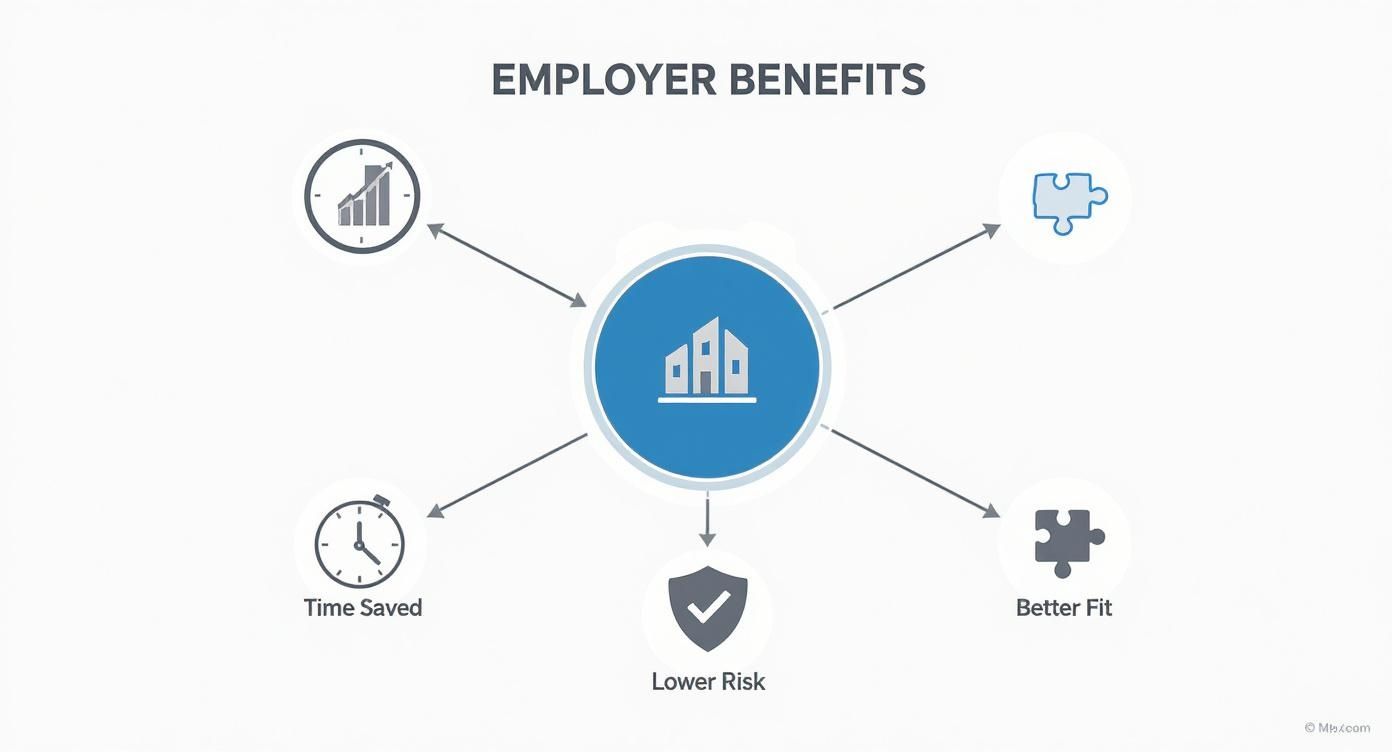
As you can see, screening interviews help companies find better-matched candidates much more efficiently, all while lowering the risk of making a bad hire.
Finally, some companies are now using automated screening tools, where an AI scans your written answers or application details for specific keywords. With this format, it’s all about making sure your responses align perfectly with the job description.
For more advice on acing any virtual interview, take a look at our guide on how to conduct an effective online interview.
Key Questions Recruiters Ask and Why
Think of screening interview questions as a recruiter's toolkit, not just random conversation starters. Every question has a job to do – it's designed to quickly get specific information about how you might fit the role. They aren't trying to trip you up; they're just building a clear picture of you, fast.
Most of these questions fall into a few distinct categories, and once you understand the "why" behind them, you can give answers that are far more impactful.
Decoding Common Screening Questions
Let’s pull back the curtain on the main types of questions you're almost certain to face. The goal here isn't just to answer them but to show you're a thoughtful, self-aware candidate who has done their homework.
1. Motivation and Interest
- "Why are you interested in this role?" This is the ultimate "prove you've done your research" question. A vague answer screams that you're just firing off applications everywhere. A specific, detailed response shows you're genuinely excited about this company and this particular job.
- "Tell me what you know about our company." This is a direct test of your prep work. Don't just repeat their "About Us" page. Mentioning a recent project, a company value that resonates with you, or a news article proves you’ve put in the time and are serious about the opportunity.
2. Qualifications and Experience
- "Can you tell me about your experience with [specific skill]?" They need to confirm what's on your CV is real. Your job is to confidently and briefly explain your hands-on experience, directly linking it to what the role requires.
- "Walk me through your CV." This is your moment to tell a compelling story about your career path. Don't just list every job you've ever had in order. Instead, focus on the highlights and wins that are most relevant to this position.
A great screening interview answer is a mini-case study. It should be brief, specific, and clearly demonstrate the value you can bring to the company from day one, answering the unspoken question: "Why should we hire you?"
3. Logistics and Practical Fit
- "What are your salary expectations?" You knew this was coming. Do your research on the market rate for this kind of role in your area so you can give a realistic range. This question makes sure there isn't a massive gap that could be a deal-breaker later on.
- "When would you be able to start?" A simple, practical check. This helps them figure out a potential hiring timeline and manage their own internal planning.
These questions are also a recruiter's first glimpse into your personality and whether you might click with the team's culture. You can dive deeper into this topic in our guide to the top cultural fit interview questions to hire better.
How to Prepare and Make a Strong Impression
Crushing a screening interview all comes down to smart preparation. Yes, these chats are brief, but they're your first real chance to prove you’re a serious contender. The mission is to go beyond just answering questions and start controlling the narrative, showing them exactly why you’re the one worth moving forward.
Think of the job description as your personal study guide. Go through it and pull out the top three to five skills or responsibilities the company is shouting about. For each one, have a specific example from your past work ready to go. This focused prep work makes sure every answer you give is relevant and hits the mark.
Next up, get your "elevator pitch" sorted. This is your chance to deliver a powerful, 60–90 second summary of who you are, what you’ve accomplished, and why you’re interested in this specific role. A polished pitch right at the start sets a confident and professional tone for the entire conversation.
Remember, a screening interview is a two-way street. You're selling your skills, but the recruiter is also selling you on the company. Come prepared not just to answer questions, but to show genuine, informed interest in what they're doing.
Your Pre-Interview Checklist
On the day, a quick checklist can be a lifesaver, helping you feel calm and organised. It’s the small details that make a huge difference in how you come across.
- Test Your Tech: If it's a video call, check your camera, mic, and internet connection well ahead of time. A dodgy connection is a terrible first impression.
- Find a Quiet Spot: Choose a professional, distraction-free space. Give anyone else in the house a heads-up so you aren’t interrupted.
- Have Your Notes Ready: Keep your CV, the job description, and your prepped examples in front of you for a quick glance if you need them.
- Prepare Your Questions: Think of two insightful questions to ask about the role, the team, or the company’s challenges. This shows you’re engaged and have done your homework.
Getting these things right helps you steer the conversation with confidence and leave a lasting impression. For a more detailed look, check out our guide on 9 techniques for effective interviewing.
Finally, don’t forget the practical upsides of this stage. Attending an in-person interview can set UK candidates back around £41 on average, and that’s before you even count lost wages. A quick 30-minute screening call is a much more efficient first step for everyone involved. You can explore more job search stats over on Standout-CV.com.
Common Questions About Screening Interviews
Even after getting the hang of what a screening interview is, a few practical questions always seem to pop up. Getting straight answers to these can make all the difference, helping you walk into that first conversation feeling prepared and confident, with no curveballs.
How Long Does a Screening Interview Usually Last?
Think quick and to the point. Most screening interviews are wrapped up in 15 to 30 minutes. The recruiter's main goal is to tick a few boxes—confirming the key details on your CV and making sure the logistics (like salary and start date) line up. It's not the time for a deep dive into your entire career.
That said, if the chat runs a bit longer, take it as a good sign. It often means the recruiter sees some real potential and is gathering extra details to make a strong case for you to the hiring manager.
The screening interview is a two-way street. While they're sizing you up, this is your first real chance to get a feel for them. Use this brief window to decide if the role, and the company culture, genuinely feel right for you.
Who Will I Be Speaking With?
Almost every time, your first point of contact will be someone from the talent acquisition team. This could be an in-house recruiter, a talent specialist, or someone from the HR department.
Think of them as the gatekeepers of the hiring process. Their job is to handle the initial vetting, filtering the sea of applicants so that only the most qualified and genuinely interested candidates move on to the next stage with the hiring manager.
What Is the Difference Between This and a First-Round Interview?
It’s easy to mix these up since they both happen early on, but they serve completely different purposes. The screening call is just a preliminary check, focusing on the absolute basics: have you got the essential skills, are your salary expectations realistic, and are you actually keen on the job?
A first-round interview, however, is the next level up. This is usually with the hiring manager—your potential future boss—and it gets much more specific. You’ll be talking about your skills in detail, walking through relevant experiences, and discussing how you’d tackle the real-world challenges of the role.
Should I Ask Questions During the Screening?
Definitely. Having one or two smart questions ready for the end shows you’re engaged and taking the opportunity seriously. You're not just another applicant firing off CVs; you're actively considering if this is the right move for you.
Try to focus on questions that show you're thinking about your potential place in the organisation.
Good topics to cover include:
- The structure of the team you'd be joining.
- What the next steps in the interview process look like.
- What does success in this role look like in the first six months?
Just keep it brief. Recruiters are often on a tight schedule, so respecting their time goes a long way.
Streamline your entire hiring journey, from screening to onboarding, with SeeMeHired. Our all-in-one applicant tracking system helps you find and hire better talent, faster. Discover how at https://seemehired.com.