SeeMeHired Insights
What is Pre Employment Screening? Essential Hiring Insights

Pre-employment screening is simply the process of checking a candidate's background, qualifications, and history to make sure they’re a suitable and safe hire. Think of it as a crucial risk management strategy for any UK business—a final quality check before you bring a new person onto your team.
Listen to the podcast here:
Decoding the Pre Employment Screening Process

Let's put it another way: pre-employment screening is just doing your due diligence before making a major business decision. You wouldn’t buy a house without a survey, right? The same logic applies here. You shouldn't onboard a new employee without first verifying their claims.
This process goes way beyond just a gut feeling from an interview. It's a structured approach to confirm that a candidate is exactly who they say they are. This isn’t about distrust, but rather a practical step to protect your company, your current employees, and your customers. A thorough screening process helps you confirm that an applicant really has the qualifications and experience they listed on their CV.
What Does Screening Involve?
The real value of pre-employment screening is in its different parts, with each one designed to paint a clearer picture of a potential hire. This can include a whole range of checks, tailored to the specific role and industry. For instance, a job handling sensitive financial data will naturally need different checks than a creative position.
Key verification steps often include:
- Identity and Right to Work Checks: This is non-negotiable. Verifying a candidate's legal right to work in the UK is a mandatory first step for all employers.
- Employment History Verification: Confirming past job titles, responsibilities, and dates of employment to check for accuracy. It’s amazing how often these details get stretched.
- Criminal Record Checks: Using the Disclosure and Barring Service (DBS) to check for relevant criminal history, which is especially important for roles involving children or vulnerable adults.
- Reference Checks: Actually speaking to previous employers to get real insight into a candidate's performance, skills, and work ethic.
A well-implemented screening process is not just a defensive measure; it’s a proactive strategy for building a high-performing, trustworthy, and resilient workforce. It sets a standard of professionalism and care from the very first interaction.
Ultimately, this whole process is about making informed hiring decisions. By confirming the details, you drastically reduce the risk of hiring someone unqualified, dishonest, or potentially harmful to your organisation. This foundational step is absolutely crucial for maintaining a safe and productive workplace.
The good news is that technology is making this easier. For example, partnerships between applicant tracking systems and screening providers now allow companies to integrate background screening directly into their hiring workflow, making these essential checks a seamless part of the process.
Why Screening Is a Business Imperative in the UK

Knowing what pre-employment screening is is the first step. But understanding why it’s become a non-negotiable for UK businesses is what truly protects your organisation. This is so much more than a box-ticking exercise; it's a strategic investment in your company’s stability, security, and future.
Bringing on a new employee is one of the biggest decisions you can make. The right person can be a catalyst for growth, while a bad hire can create ripples that disrupt everything—morale, productivity, and your bottom line.
Think of it this way: you’re about to grant someone access to your premises, your systems, your finances, and your team. That’s an immense amount of trust. Pre-employment screening is simply the process of validating that trust, ensuring it’s well-placed from day one. It shifts hiring from a gamble based on a CV to an informed, data-driven decision.
Shielding Your Business from Tangible Risks
A single bad hire can have a devastating impact, creating tangible and often costly problems. Proper pre-employment screening acts as your first line of defence against a whole range of threats that UK businesses face every single day.
The financial fallout alone can be staggering. An employee with a history of fraud could easily exploit weaknesses in your accounts. Someone with an undisclosed substance abuse problem might cause an accident, leading to hefty compensation claims and operational downtime.
And beyond the direct financial hit, the reputational damage can be even worse. An employee involved in misconduct can tarnish your brand, erode customer trust, and make it much harder to attract top talent down the line.
Pre-employment screening is not about catching people out. It's about ensuring a safe, honest, and productive environment for everyone by verifying that candidates are suitable for the trust you are about to place in them.
This proactive approach is fundamental to building a resilient and dependable workforce. By verifying credentials and histories, you protect your company’s assets, ensure a safe environment for your team, and uphold your business’s integrity.
Addressing the Rising Tide of Insider Threats
Here in the UK, the landscape of workplace risk is constantly changing. Fraudulent activity is a huge concern, making thorough background checks more critical than ever. A recent CIFAS report revealed that fraud now accounts for a staggering 41% of all crime in the UK, with insider threats becoming alarmingly common.
These incidents can range from employees hiding damaging histories to actively working for competitors while still on your payroll. It’s a stark reminder that screening is no longer just about matching skills to a job description; it’s a core security measure.
Here’s where screening provides indispensable protection:
- Preventing Financial Loss: Verifying a candidate’s history helps uncover red flags related to financial misconduct, protecting company funds and sensitive data.
- Ensuring Workplace Safety: For roles involving driving, operating machinery, or caring for vulnerable people, criminal record checks are absolutely vital.
- Validating Qualifications: Confirming education and professional certifications ensures you’re hiring genuinely qualified people, preventing performance issues or safety breaches caused by incompetence.
- Protecting Company Reputation: A rigorous screening process demonstrates due diligence, shielding your brand from the fallout of an employee’s dishonest or illegal actions.
Upholding Legal and Compliance Obligations
Finally, let’s not forget that carrying out the right checks is often a matter of legal compliance. For many regulated UK industries—like finance, healthcare, and education—specific background checks are mandatory. Getting this wrong can lead to severe penalties, including hefty fines and even the loss of your licence to operate.
On top of that, all screening must be conducted in line with UK law, particularly GDPR and the Data Protection Act 2018. This legal framework demands a process that is fair, transparent, and respectful of a candidate’s privacy. For a deeper dive, check out our essential guide for UK hiring teams on GDPR in recruitment.
By implementing a robust and compliant pre-employment screening policy, you not only reduce risk but also build a foundation of trust and integrity that will define your company culture for years to come.
The Core Components of a Screening Process
A pre-employment screening process isn’t a one-size-fits-all activity. Think of it as a toolkit, where each tool is designed for a specific job. As a hiring manager, your role is to pick the right combination of tools to build a complete, honest picture of a candidate. The key is making sure the checks are always relevant to the role's demands and risks.
This infographic lays out the main categories that screening methods fall into, giving you a clear overview of your options.
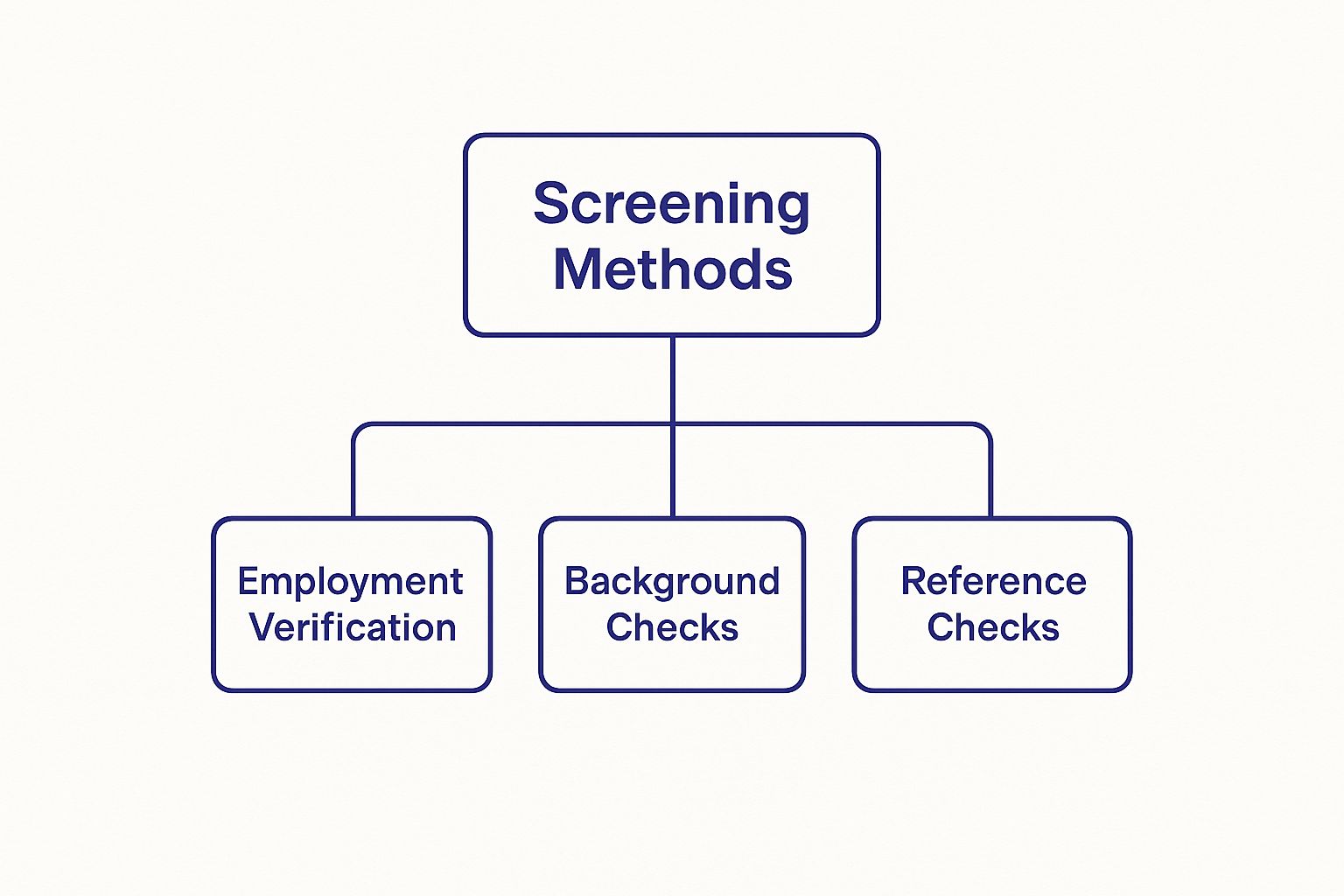
As you can see, a strong process relies on more than just one type of check. It combines verification, background investigation, and personal insights to create a truly comprehensive profile.
Let's break down the most essential components you can build into your screening programme.
Foundational Verifications for Every Hire
Some checks are so fundamental they should be part of nearly every hiring process in the UK. These verifications confirm the absolute basics, ensuring your candidate is who they say they are and is legally allowed to work.
- Right to Work Checks: This is a legal must-do for every UK employer. Before anyone starts, you have to verify their legal right to work here. Failing to do so can lead to massive fines and serious legal trouble.
- Identity Verification: This simply confirms that the candidate is genuinely the person they claim to be, usually by checking official documents like a passport or driving licence. It’s the very foundation of trust that all other checks are built on.
- Address History Verification: This check confirms where a candidate has lived over a set period. It's often a necessary step for running other checks, like criminal record and credit history reports.
Digging Deeper with Background Checks
Once the basics are confirmed, you can move on to more detailed background checks. The depth and type of these checks will depend entirely on the role's responsibilities and the level of trust required.
A tailored screening process is a fair screening process. You should only run checks that are necessary and proportionate to the job. For a clearer idea of how this fits into the bigger picture, you can explore the 8 stages of a solid recruitment process.
To get this right, it's helpful to understand the common checks and what they're for.
Common Pre-Employment Checks and Their Purpose
This table breaks down some of the most frequently used pre-employment checks, what they actually verify, and the types of roles where they are most critical.
| Type of Check | What It Verifies | Most Relevant For |
|---|---|---|
| Right to Work | Candidate's legal eligibility to work in the UK. | All roles (legal requirement). |
| Criminal Record (DBS) | Unspent/spent convictions, cautions, and inclusion on barred lists. | Roles working with children or vulnerable adults; finance, legal, and security sectors. |
| Credit History | Financial responsibility and history of managing debt. | Roles with financial responsibility, such as accounting, banking, or senior management. |
| Employment History | Previous job titles, dates of employment, and reasons for leaving. | All roles, to confirm the experience claimed on a CV. |
| Education & Qualifications | Authenticity of degrees, certifications, and professional memberships. | Roles requiring specific technical skills or professional credentials (e.g., medical, legal, engineering). |
| Driving Record (DVLA) | Driving licence validity, penalty points, and disqualifications. | Roles that involve driving a company vehicle or operating machinery. |
Having this context helps you choose only the most relevant checks, ensuring your process is both effective and fair. Let's look at a couple of these in more detail.
Criminal Record Checks (DBS)
In the UK, the Disclosure and Barring Service (DBS) is the official body for criminal record checks. There are different levels available, depending on the role's nature:
- Basic DBS Check: Reveals any 'unspent' convictions and conditional cautions. Any employer can request this with the applicant's consent.
- Standard DBS Check: Shows both spent and unspent convictions, cautions, reprimands, and final warnings. This is available for specific roles, like those in law or finance.
- Enhanced DBS Check: Includes everything in a Standard check, plus any relevant information held by local police forces. It’s required for roles involving work with children or vulnerable adults.
- Enhanced with Barred Lists Check: This is the highest level, confirming the applicant is not on a list of individuals barred from working with children or vulnerable adults.
Credit History Checks
For roles that involve handling money, managing budgets, or holding significant financial responsibility (think finance or accounting), a credit check can be vital. This check gives you a window into a candidate’s financial history and responsibility, but it does not affect their credit score. It's purely used to spot potential risks of fraud or financial mismanagement.
Validating Experience and Qualifications
Finally, these checks are all about verifying the claims a candidate has made on their CV. Is their professional and academic history accurate?
Employment History Verification This is a straightforward but crucial step. It involves contacting previous employers to confirm a candidate’s job title, employment dates, and sometimes their reason for leaving. This simple check is brilliant at uncovering any discrepancies or exaggerations, confirming their stated experience is genuine.
Education and Qualification Verification For any role where a specific degree or professional certification is a non-negotiable requirement, this check is essential. It involves contacting the university or professional body to confirm that the candidate actually holds the qualifications they claim. This is critical for maintaining professional standards and avoiding the huge risks associated with unqualified staff, especially in technical or regulated fields.
Navigating UK Screening Laws and Compliance

Running checks on candidates is only half the battle. The real challenge—and the part that truly protects your organisation—is doing it correctly and legally. Let’s be honest, the legal side of pre-employment screening in the UK can feel like a minefield, but it's a non-negotiable part of hiring.
Getting this wrong isn't just about a slap on the wrist. It can lead to serious legal trouble and hefty fines, not to mention the damage to your reputation. But this isn’t about becoming a legal scholar overnight. It’s about grasping the core principles that govern how you collect, handle, and use a candidate's personal data. Your entire screening process needs to be built on a foundation of fairness, transparency, and relevance to the job itself.
GDPR and the Data Protection Act 2018
When it comes to handling data in the UK, two names loom large: the General Data Protection Regulation (GDPR) and the Data Protection Act 2018. Think of these as the rulebook for your screening process. They give candidates specific rights over their information and place clear responsibilities on you as the employer.
Under these laws, you can’t just run checks on a whim. You must have a lawful basis for processing someone's data. For most screening activities, that lawful basis is getting the candidate’s explicit, informed consent.
The golden rule of compliant screening is simple: be transparent, be relevant, and always get consent. You are the temporary guardian of a candidate's personal information, and you must treat it with the respect and security it deserves.
This means you need to be upfront with candidates about what checks you plan to run, explain exactly why they’re necessary for that specific role, and tell them who will see the information. A vague, blanket consent form just won’t cut it.
The Pillars of a Lawful Screening Process
To keep your screening process firmly on the right side of the law, you need to build a few key principles into your hiring policy. These pillars don’t just ensure you're compliant; they help create a fair and respectful experience for every applicant.
Here’s what you absolutely must do:
- Obtain Explicit Consent: Before you do anything, you must get clear, written consent from the candidate. This form needs to spell out exactly which checks will be performed.
- Ensure Relevance and Proportionality: The checks you run must be directly related to the job. For example, running a credit history check for a graphic designer with no financial duties would almost certainly be seen as disproportionate and unlawful.
- Communicate Transparently: Keep candidates in the loop. Tell them what to expect, the likely timescales for checks, and what happens next.
- Handle Data Securely: All the personal data you collect must be stored securely. Access should be restricted only to those who are directly involved in the hiring decision.
Data privacy rules like GDPR have completely reshaped how screening is done, forcing employers to be much more careful. As a result, UK companies are investing more in secure tech like encryption and access controls to keep candidate data safe.
Avoiding Discrimination in Screening
One of the biggest legal risks you face is discrimination. It’s critical that your screening policy is applied consistently to all candidates for the same role. Any hint of bias could land you in hot water.
Applying different levels of scrutiny based on protected characteristics like age, race, or gender is illegal. For example, if you decide a DBS check is needed for a particular role, you must run that check for every single candidate who reaches that stage. Cherry-picking who you check is a fast track to a discrimination claim.
It’s also crucial to handle any negative findings fairly. If a check uncovers something, you have to assess its relevance to the specific duties of the job. A minor issue from years ago might be completely irrelevant to the role you're hiring for.
For a deeper dive into these legal requirements, check out our detailed UK background check compliance guide. It’s packed with actionable advice to help you build a process that’s both effective and fully compliant.
How to Implement a Fair and Effective Screening Policy
Knowing the legal rules is one thing, but turning that knowledge into a practical, everyday policy is where the real work begins. This is how you build a truly robust hiring process. Think of an effective screening policy as your company's blueprint for making fair, consistent, and defensible hiring decisions. It’s not about adding red tape; it's about removing guesswork so everyone on your team is on the same page.
This isn’t about creating a rigid, bureaucratic document that gathers dust. Instead, it’s a clear set of guidelines designed to protect both the business and your candidates. A well-defined policy ensures that every applicant for a specific role goes through the exact same process, which is fundamental to avoiding discrimination and building a trustworthy employer brand.
The Three Pillars of a Strong Policy
To be both effective and equitable, your pre-employment screening policy needs to be built on three non-negotiable principles. These pillars ensure your process is logical, fair, and directly supports your business goals without overstepping legal or ethical boundaries.
- Consistency: The policy must be applied uniformly to all candidates applying for the same role. You can't run a credit check on one applicant but skip it for another. This consistency is your best defence against any claims of bias.
- Transparency: Candidates have a right to know what checks you are conducting and why. Being upfront about your process from the very beginning builds trust and creates a much more positive candidate experience.
- Relevance: Every single check you perform must be directly relevant to the duties and responsibilities of the job. A check should only be included if it genuinely helps you assess a candidate's suitability for that specific position.
Developing Your Screening Framework
Creating your policy involves a few straightforward but critical steps. Start by identifying the unique risks associated with different roles in your organisation. A public-facing role in hospitality is going to have very different screening needs than a back-office finance position, for example.
Next, clearly document which checks are required for each type of role. This creates a standardised approach that anyone can follow. You might decide that all roles require Right to Work and employment history checks, while only roles with financial responsibilities need a credit check.
Your policy should be a living document, not something you write once and forget. Regularly review and update it to reflect changes in legislation, your business needs, and best practices in recruitment.
Finally, outline the entire process from start to finish. This needs to include how and when you will get consent, who will have access to the screening results, and how the information will be stored and eventually destroyed in line with GDPR.
Handling Red Flags and Discrepancies
No screening process is perfect, and you will eventually encounter discrepancies or "red flags." This could be anything from a mismatched employment date to a more serious issue uncovered in a criminal record check. How you handle these situations is the true test of your policy's fairness.
The key is to remain objective. Never make a snap decision based on a single piece of information. The first step should always be to verify the accuracy of the finding—mistakes can and do happen with background check providers.
If the information is accurate, the next step is crucial: assess its relevance. Ask yourself, "Does this finding directly impact the candidate's ability to perform this specific job safely and effectively?" A past driving offence, for instance, might be totally irrelevant for an office-based role but an absolute deal-breaker for a delivery driver. If it's appropriate, always give the candidate an opportunity to provide context or an explanation.
Using Technology to Streamline Your Policy
Trying to implement and manage a screening policy manually can be incredibly time-consuming and is often prone to human error. This is where modern HR technology, like an Applicant Tracking System (ATS), becomes invaluable.
An ATS like SeeMeHired can automate and standardise your workflow from start to finish. You can build your screening requirements directly into the hiring stages for each role, ensuring no steps are ever missed. The system can automatically request consent from candidates and integrate with your screening providers to kick off checks at exactly the right time.
This doesn't just save a huge amount of admin; it also helps maintain compliance by creating a clear, auditable trail of your actions. By automating these steps, you also create a much smoother process for everyone involved, which is a key part of learning how to create an outstanding candidate experience.
Your Blueprint for Safer and Smarter Hiring
So, we've walked through the ins and outs of pre-employment screening, and it’s clear it's much more than a box-ticking exercise. Think of it less as an obstacle in your hiring journey and more as the bedrock of smart, responsible recruitment here in the UK. It’s a fundamental practice that protects your most valuable asset: your people.
By weaving a thoughtful and consistent screening process into your recruitment, you shift from simply reacting to problems to actively preventing them. This isn’t just about dodging a bad hire; it's about deliberately building a safer workplace, protecting your current team, and safeguarding the reputation you’ve worked so hard to build. Every check you run is a clear step towards a culture of trust and integrity.
Pre-employment screening is your commitment to quality, safety, and excellence, shown long before a new hire’s first day. It's an investment in your company's resilience that pays you back in stability and growth.
Consider this your call to action. Take the insights from this guide and hold them up against your current hiring practices. Where are the gaps? What are the specific risks in your industry and for the roles you're hiring for? It’s time to take decisive steps to build a more secure and efficient system.
This proactive approach is the cornerstone of building a stronger, more dependable organisation from the ground up. By embedding thorough screening into your recruitment DNA, you're not just hiring employees—you're investing in a more secure and successful future for your entire business.
Frequently Asked Questions
When it comes to pre-employment screening, there are always questions. It’s completely normal, especially when you’re trying to balance thoroughness with UK law and creating a good candidate experience. Let’s tackle some of the most common queries we hear from hiring managers.
How Long Does Pre-Employment Screening Take in the UK?
Honestly, it depends. There’s no single answer because the timeline is dictated by how deep you need to go with your checks.
A straightforward identity and Right to Work check? You could have that back in a day or two. But if you're hiring for a role that needs more comprehensive screening—think a full DBS check, chasing down multiple references, and confirming past employment—you’re likely looking at a timeframe of one to four weeks.
The real key here is managing expectations. Be upfront with your candidates about your estimated timelines. It keeps the process positive, shows respect for their time, and stops them from getting frustrated and dropping out.
Is Candidate Consent Required for Background Checks?
Yes, absolutely. This one is non-negotiable.
Under both GDPR and the UK's Data Protection Act 2018, you must get explicit, written consent from a candidate before you start any background checks. Kicking off the process without their permission isn't just bad practice; it's a serious legal breach.
And it can’t just be a tick-box exercise. The consent has to be informed, which means you need to clearly spell out:
- What specific checks you’ll be running.
- Why those particular checks are relevant to the role they've applied for.
- Who will see their data and how you'll keep it secure.
A vague, catch-all statement in the small print just won’t cut it. Transparency is your best friend when it comes to compliance.
What Happens If a Screening Reveals Negative Information?
First things first: don’t panic or jump to conclusions. Finding a discrepancy or some negative information requires a calm, fair, and consistent approach.
Remember, the point of screening isn't to catch people out—it's to assess genuine risk. Your first step should be to look at the information in the context of the specific job, not in isolation.
Have a clear process for this scenario. Start by double-checking the information with your screening provider to make sure it's accurate. Then, take a step back and objectively consider its relevance. A past credit issue might be a massive red flag for an accountant, but it could be completely irrelevant for a graphic designer.
Finally, the best approach is to actually talk to the candidate. Give them a fair chance to provide some context or explain the situation. This simple conversation allows you to make a fully informed—and legally defensible—hiring decision.